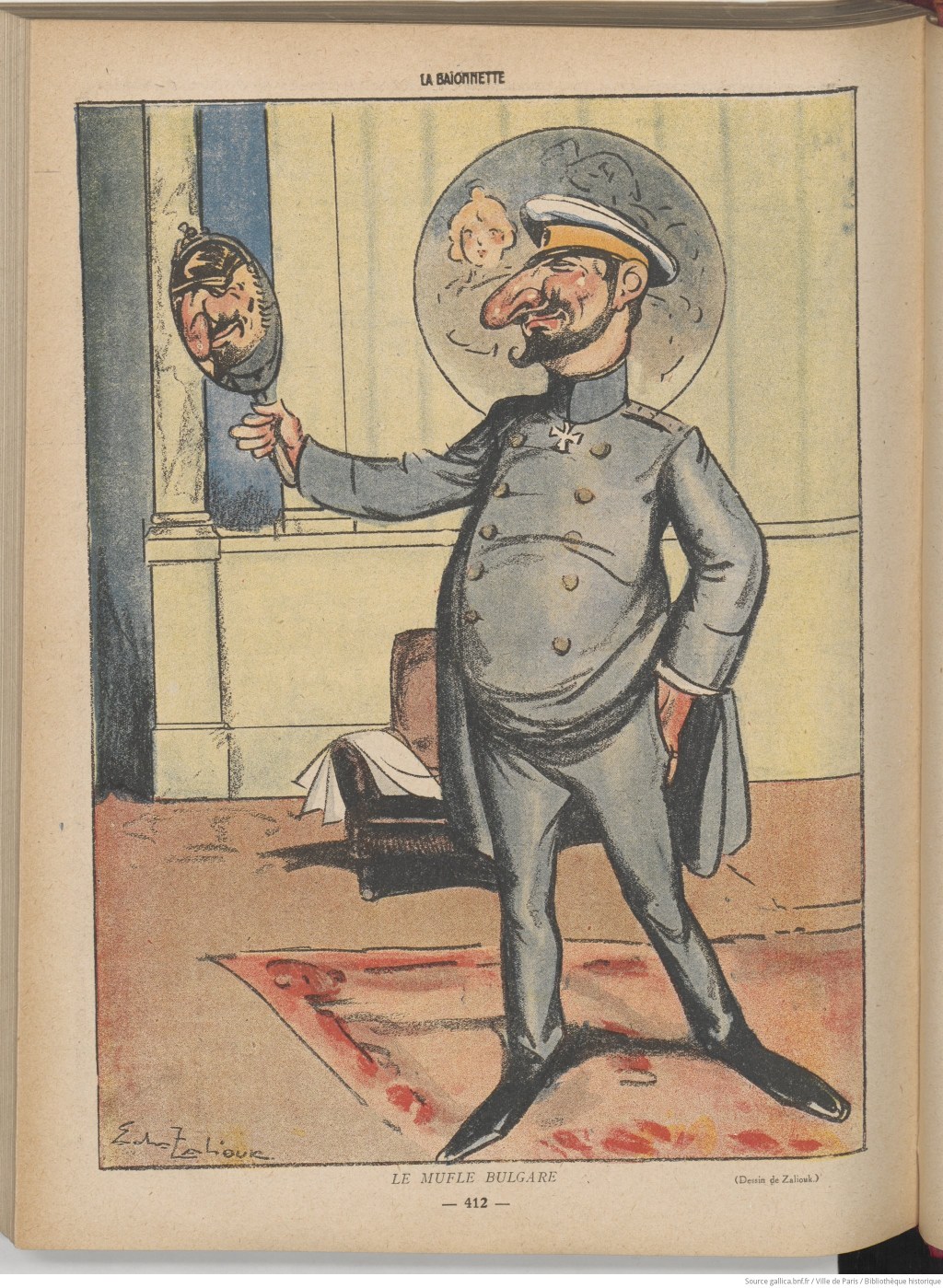
‘Journaux de tranchées‘, or trench journalism, is exactly that: publications by soldiers locked in the horrors of war. This form of transmitting the misery, violence and loss of a war by those closest to it, was not unique to France, as Britain and Germany had their own publications (source), though France had quite a few (some examples listed here). Indeed,
Trench journalism included written or artistic pieces. Sacha contributed in both forms.
Firstly, on the written side:
In my previous post about Moussa Koné Beyla (source), I noted that “there was a publication called ‘Bulletin des écrivains’ which had a section at the back. It contained columns listing the location of writers. Sacha was included in these columns for several months, and so we can trace where he was placed, at least roughly.” There were notices of dead or missing soldiers in this publication too, which underscores the sorrow and grief that was undoubtedly felt by those hoping to never find the names of a loved-one on those particular pages.
This week, I stumbled across a different monthly publication from the war called ‘Gazette des Cormon, Collin, Flameng et des ateliers de gravure’. All editions can be found for free on Gallica (source) and these editions include messages from soldiers – some are very short, some very long. If you speak French, I encourage you to read them all.
When I searched ‘Zaliouk’, I had some results. Sacha’s surname is quite unique, and so I tend to think it is indeed him who appears in some of these publications with his own messages.
I’ll include them below:
1. November 1916 Edition (source)
Original
Oiseaux de Passage
BARTHELEMY, MARTIN SAUVAIGO*, HENDERYCKSEN, ZALIOUK, FERNIER, HOFFMANN, KAISER, FONT. LESELLIER, DIEY, PLANES, J. RICHARD, EVRARD, LAVALLARD, DEGORGE, BLANACHARD.
Translation
Birds of passage**
BARTHELEMY, MARTIN SAUVAIGO, HENDERYCKSEN, ZALIOUK, FERNIER, HOFFMANN, KAISER, FONT. LESELLIER, DIEY, PLANES, J. RICHARD, EVRARD, LAVALLARD, DEGORGE, BLANACHARD.
*I believe Charles Martin-Sauvaigo.
**This is the literal meaning, I presume meaning someone who is passing through or not staying very long in a specific area? There is no full message from Sacha. But I would invite any native French speakers or those more familiar with WWI history to correct me and add context!
2. January 1917 Edition (source):
Original
ZALIOUK – Merci à Mademoiselle Vosy pour le petit colis et les bons souhaite. Espérons réveillonner ensemble l’année prochaine.
Translation
ZALIOUK – Thank you to Mademoiselle Vosy for the little package and the well wishes. Hoping to celebrate the next year together.
3. September 1917 Edition (source):
Original
ZALIOUK – Pour le moment jes suis en bonne santé toujours en course, car je suis agent de liaison, cycliste, à pied et enfin motocycliste. Je continue à servir dans le même group quoique j’ j’avais quelques idées de quitter le front, mais à présent si je ne suis pas …. zig …. je tacherai d’aller revoir mes frères Russes, qui ne sont pas toujours d’accord. Je veuxyy aller si c’est possible et faire une propagande en faveur de la France. Mes Amitiès aux Copains [sic]
Translation
ZALIOUK – For the moment, I am in good health and still on the go, because I am a liaison officer, cyclist, on foot, and finally a motorcyclist. I continue to serve in the same group, although I’ve had some thoughts about leaving the front, but now if I’m not… zig*… I’ll try to go there** and see my Russian brothers again, who don’t always agree. I want to go there if possible and spread propaganda for France. My best regards to my friends [sic].
*The original indeed has the ellipses and ‘zig’ that I can make out, but I’m not sure what this means, hence I left it as it appears.
**’Je veuxyy aller’ – I know the double ‘y’ is probably an error and think perhaps it is ‘je veux y aller’ which makes sense in this context to me.
So, for the November 1916 edition, we can compare with the Bulletin. In its May edition (source), it provides the following address, which remains the same for the editions that follow all through to November:

In January 1917, not quite as direct (source):

For September 1917, it refers back to its April edition which I can’t seem to see. In any case, it is in that month that Sacha is sent ‘en Orient’ – over to the East, where he ends up stationed for ‘twenty-two months between Thessaloniki and the Romanian border’ (source), and I delve into more detail on this time in his biography.
Artistic contributions:
La Baïonnette
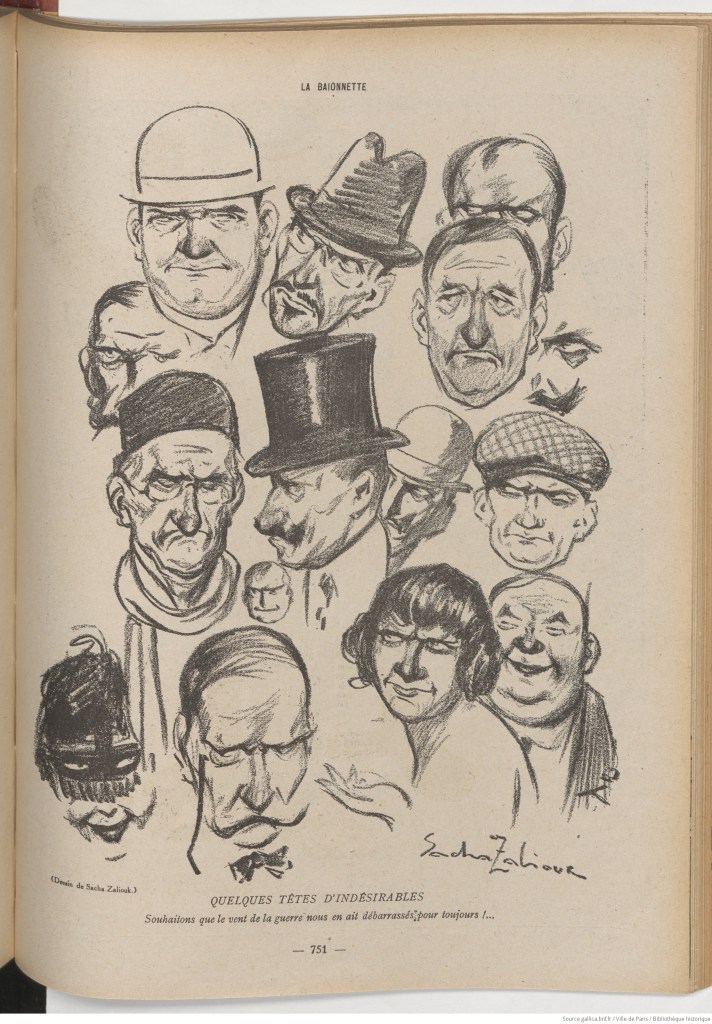
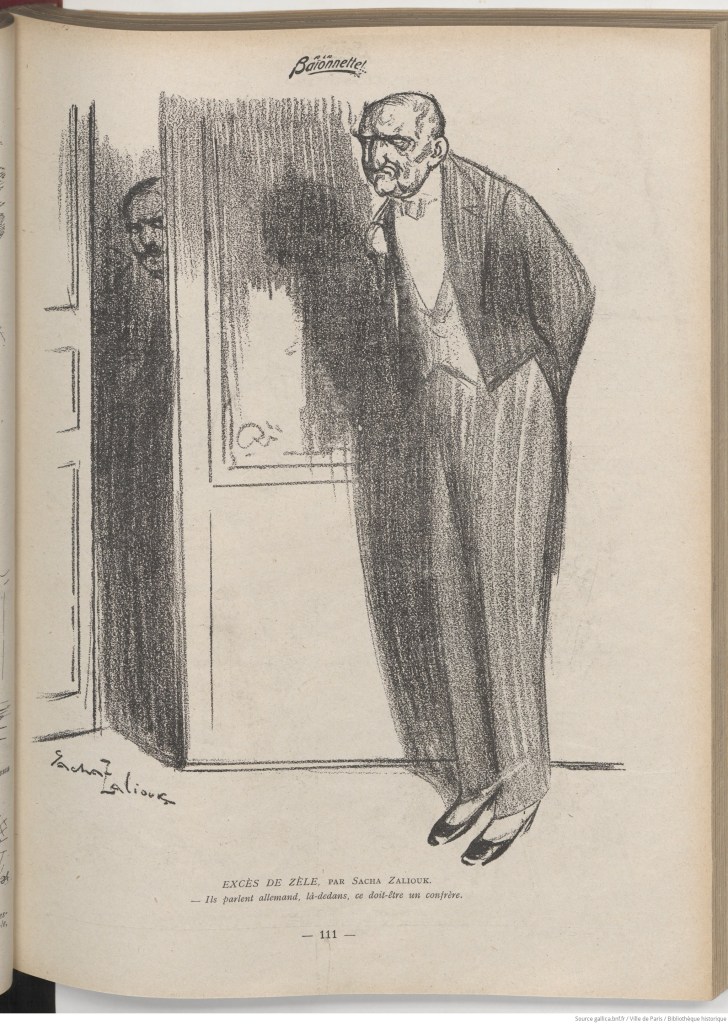
Sacha contributed to various satirical magazines during the war, including La Baïonnette, one of the most well-known and which included more direct depictions of the war than the society of the time expected (source). The featured image of this post comes from its December 1915 edition (source) and more from La Baïonnette are shown below:
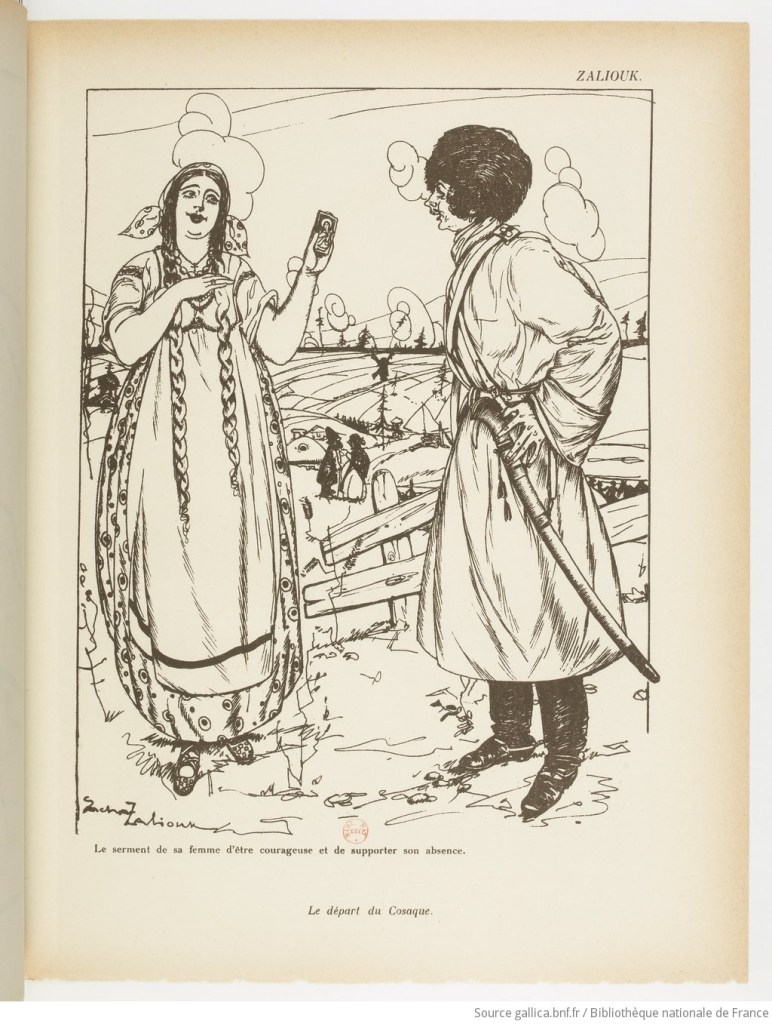
La Grande Guerre (collection):
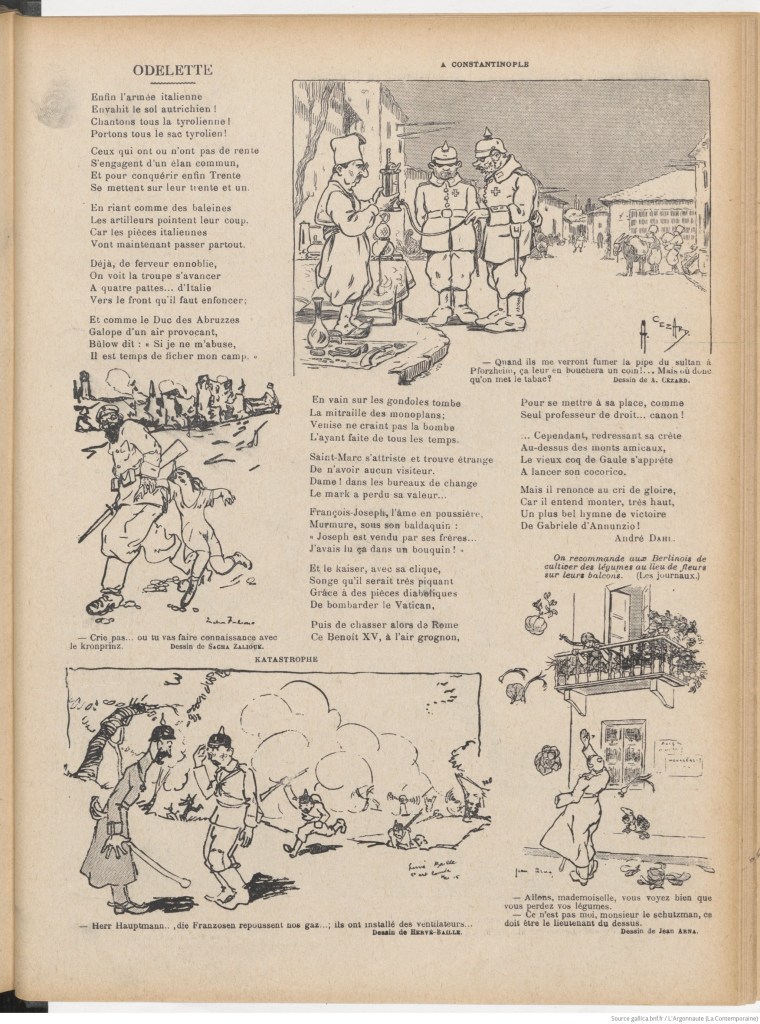
*Sacha’s drawing is on the left of the page, in the middle, showing a woman being dragged. Caption reads “Don’t cry…or you’ll be introduced to the Kronprinz.”
 A Study of Sacha Zaliouk
You must be logged in to post a comment.